
REVIEW · LOMBOK AND MOUNT RINJANI ADVENTURES
Mount Rinjani 2 Days and 1 Night to Senaru Crater Rim
A mountain crater rim beats a viewpoint any day. This 2D/1N trek gives you Senaru crater-rim camping plus serious jungle hiking without the pressure of a summit push. For me, it is the best kind of Rinjani day trip, the kind where the scenery is earned step by step.
Two things I really like: the way you wake up to a sunrise framed between Mount Rinjani and Mount Sangkareang, and the fact that you camp with full setup so your brain can focus on the view. One drawback to consider: this is still a challenging hike for people who do not hike regularly, and you should be ready to handle basic mountain conditions.
In This Review
- Key things to know before you go
- Why the Senaru crater rim trek feels special
- Day 1: Registration at the gate, then jungle walking uphill
- Night at the crater edge: camping setup and the view payoff
- Names worth noting from real guides
- Day 2: sunrise, then descend back to Senaru through rainforest
- What you actually get, and how to pack around it
- Included (from the program details)
- Not included (so you must bring it)
- Price and logistics: is $152 a good deal?
- Who this trek suits best (and who should think twice)
- Your hiking reality check: what to expect on the trail
- Should you book Mount Rinjani 2 Days and 1 Night from Senaru?
- FAQ
- What is the meeting point for this trek?
- What time does the trek begin?
- How long is the experience?
- Is the tour private?
- What route does the trek follow?
- How much hiking height change should I expect?
- What is included in the price besides the guide?
- What personal items should I bring?
- Is the Mount Rinjani entrance fee included?
- What fitness level do I need?
- What is the cancellation policy?
Key things to know before you go
- Crater rim camping, not a summit slog: you get the crater edge experience and big mountain views while keeping it realistic for beginners.
- Senaru route through trees: most of your time is in rainforest-like terrain, which can feel cooler and more “alive” than open slopes.
- Altitude jump matters: you go from about 600 m up toward roughly 2,641 m, so pace yourself.
- Guides and porters are a big part of the value: the operation is built around that team, not just a downloadable map.
- Gear is largely handled: tents, sleeping gear, trekking poles, water, and even a toilet tent are included.
- Ask about food needs and medical support: one review flagged diet handling and first-aid/medical support gaps, so it’s smart to plan ahead.
Other Lombok days, coast and volcano
Why the Senaru crater rim trek feels special
This trek is popular for a reason: it lets you experience Mount Rinjani without aiming for the hardest summit goal. You start from Senaru village and head up through a wooded route, then spend the night near the edge of the crater where the views are the whole point.
From camp, you get an up-close look at the summit lake area and a clear view of Baru Jari Mountain. You also get a perspective that most short hikes never deliver, including half of Lombok and the three Gilis that you can see from this vantage point. That means you are not just looking at one peak, you are seeing the island geometry, the way the mountains and sea layers stack up.
The best part is the timing. In the morning, you are set up to watch sunrise between the summits of Mount Rinjani and Mount Sangkareang. At the end of Day 1, the description also points to sunset toward the tip of Bali. That combination, sunrise at the crater, sunset across open water, is what makes this feel like a full mountain story in two days.
Day 1: Registration at the gate, then jungle walking uphill
Your day starts early, typically around 7:00 to 7:30 AM in Senaru. Before you start hiking, you go to Rinjani National Gate for registration and a briefing with your guide. That matters more than it sounds. Rinjani operations can change with conditions, and having a briefing helps you understand what to expect on your particular day.
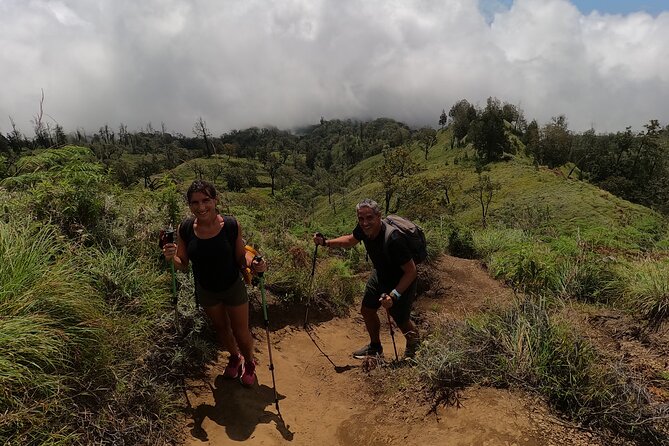
Once you start, the route is the Senaru route, described as trekking through trees and dense forest. You are walking through a tropical environment rich in flora and birdlife, which often makes the hike feel less monotonous. Even when the incline is steep, the forest gives you visual breaks, shade, and something different to look at besides the trail switchbacks.
You begin around 600 m and climb to much higher terrain over the course of the day. The exact rhythm depends on weather and your group, but the altitude change is significant, so use a slower pace than you think you need. If you push too hard early, you will feel it later, especially once you approach the camp area.
At the end of Day 1, you are moving toward the crater rim camping area. This is where the program wins you over, because you are not ending the day with a vague “good view.” You are arriving near the crater edge designed for the sunrise and the long sightlines.
Night at the crater edge: camping setup and the view payoff
After your first trekking day, you settle in for your overnight stay right at the crater rim area. The big practical advantage here is that the camp setup is included. You get double-size tents, camp chairs, a toilet tent, and full sleeping bag, pillow, and mattress support. Even the small stuff like camp gear being carried for you helps a lot, because it means you spend less energy on logistics and more on the hike and the view.
The program is also designed around timing. One night is all it takes to hit both the night experience and the next morning’s sunrise. And because you are camped near the crater edge, the morning light hits the mountains in a way that is hard to recreate from a day trip.
If your group includes kids, a honeymoon couple, or someone who is fit but new to hiking, this style tends to work well. It is still physical, but you are not asking everyone to perform at summit-level intensity. The reward comes from being camped in the right place, not from a ticket to the very top.
Names worth noting from real guides
In the real-world experience reports, guides like Rizal, Ibrahim, and Sapar come up as strong presences. There are also porter names like Jul and Amat in one account. Having a good guide and porters matters because on a hike, they are not just carrying gear. They manage pace, steps, and your sense of safety when the trail gets steep or uneven.
- Tetebatu Walking Tour – Rice Terraces, Waterfall & Monkey Forest★ 5.0 · 349 reviews
- Day Trip 5 Secret Gilis : Layar, Rengit, Nanggu, Tangkong, Kedis★ 5.0 · 192 reviews
- 2D1N Senaru Crater Rim Trekking★ 5.0 · 178 reviews
- Explore Komodo and Swim with Whale Sharks★ 5.0 · 138 reviews
- Lombok Pink Beach Boat Trip (Full Day + Snorkeling)★ 5.0 · 104 reviews
Day 2: sunrise, then descend back to Senaru through rainforest
Day 2 starts after breakfast with a sunrise experience. The idea is that you are leaving Mount Rinjani behind and descending back to Senaru through the rainforest terrain.
That direction matters. Going down is not automatically easy, but it is often easier than climbing. Still, descending can be tough on knees and ankles, especially after a day of uphills. Expect a slower rhythm, longer attention to footing, and a need for trekking poles.
If you are lucky, you may spot the rare black monkey on the way. That kind of wildlife sighting is never guaranteed, but the forest setting increases your odds compared with a more barren route.
The Day 2 total hike time is listed around 6 hours, so you should plan for a solid finishing push. When the day ends, the activity comes back to the meeting point in Senaru. The program also includes the transfer from Senaru to the starting trek on Day 1, which removes a hassle that many independent setups force you to solve yourself.
What you actually get, and how to pack around it
This is where the value shows up. The tour includes food, water, and the core “camp survival” elements.
Included (from the program details)
- Guide plus a porter team to carry camping equipment
- Camping equipment, including tents, sleeping bags, pillows, mattress, camp chairs, and a toilet tent
- Trekking poles and sticks
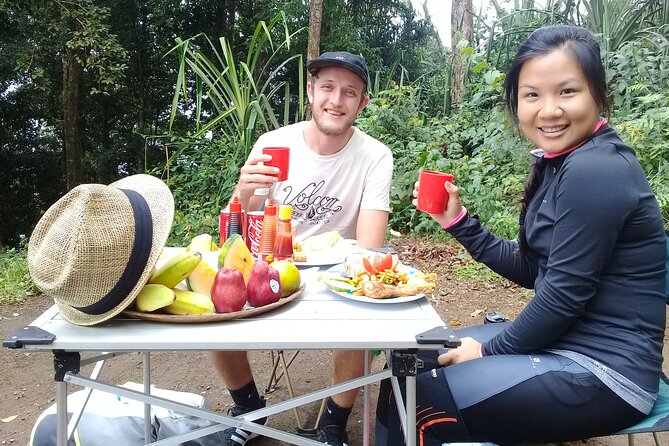
- Dinner, two lunches, and two breakfasts
- Safe drinking water
- Rain coat
- Insurance
- Transfer from Senaru to the starting trek
- Meeting and ending at the Senaru area
Not included (so you must bring it)
- Entrance fee for Mount Rinjani (plan for this budget line)
- Trekking shoes, plus long pants and gloves
- A small day pack plus warm jacket and wind jacket
My packing advice: treat this like a mountain hike first, and camping second. You will feel temperature changes, and wind can happen quickly at higher elevations. Bring layers that you can adjust, and do not assume you can rent proper hiking footwear on the spot.
Also, if you have dietary restrictions, do not wait until the morning of. One account pointed to serious gaps on diet handling, and that is the kind of problem you want to prevent, not troubleshoot at altitude.
Price and logistics: is $152 a good deal?
The price is $152 per person for 2 days and 1 night, and the listing also notes group discounts. The key question is where the money goes, because that is what determines whether you feel “smart” after you book.
Here is what helps make the price feel more reasonable than a basic tour: you are not just paying for a guide. You are paying for a full system:
- camping gear and setup are included,
- food is covered for two breakfasts, two lunches, and dinner,
- safe water is provided,
- trekking poles and sticks are included,
- a porter team carries the heavier camp equipment.
On Rinjani, porters are not optional comforts, they are how the trek stays manageable for people who are not trying to haul their whole home on their back.
Where costs can pop up anyway: the Mount Rinjani entrance fee is not included, and you still need your personal clothing and trekking shoes. If you already have good footwear and layers, your total cost stays closer to the quoted figure.
Who this trek suits best (and who should think twice)
This program is described as suitable for beginners and families, and that matches the overall design. You get a crater rim camping experience, which is the core Rinjani “wow,” without demanding a summit effort.
You should be a good fit if:
- you have moderate fitness and can hike uphill for hours,
- you want a guided trek with a strong support setup,
- you value the sunrise and crater views enough to accept a tough couple of hiking days.
You should think twice or plan extra carefully if:
- you are not used to hiking at altitude or uneven ground,
- you have strict dietary needs and cannot be flexible,
- you require advanced medical support on a trek (one review flagged first-aid/medical support gaps).
Also, if you like having a choice in group pacing, note that a private tour means it is only your group, but it does not automatically mean it will feel like a personal guided tour. A guide still needs to keep timing for registration, trail conditions, and camp setup.
Your hiking reality check: what to expect on the trail
Even with crater rim camping, the hike is still work. You are climbing from about 600 m up toward around 2,641 m, and the change in air and temperature can make the effort feel more intense than you expected.
One review called it challenging but manageable, and that is a fair description for most first-time hikers if you:
- take it slow early in the day,
- keep a steady pace rather than power through,
- use the provided trekking poles for downhills.
Another practical point: the program is built around trees and rainforest terrain. That can be great for shade, but it can also mean slippery sections after moisture. Keep your footing calm and your brain present.
Finally, the whole experience is a team effort. In multiple notes, the guide and porters were praised for being caring and supportive. Names like Ibrahim and Rizal show up for exactly that reason: they help you through the hike, not just through the paperwork.
Should you book Mount Rinjani 2 Days and 1 Night from Senaru?
If you want the real Rinjani feeling in a time-efficient package, I think this can be a smart booking. The big reasons are simple: crater rim camping, sunrise between Rinjani and Sangkareang, and a route that starts in the jungle rather than immediately punishing you with a summit mission.
Book it if you:
- want a guided, gear-supported trek,
- like the idea of camping with setup done for you,
- can handle a tough hike with a steady pace.
Skip or research more if:
- you have complex dietary requirements and need certainty,
- you are very sensitive about medical support on remote treks,
- you expect a light walk, because this is not that.
FAQ
What is the meeting point for this trek?
The start is in Senaru, Bayan, North Lombok Regency, West Nusa Tenggara, Indonesia, and the activity ends back at the meeting point.
What time does the trek begin?
The start time is 7:00 AM.
How long is the experience?
It is 2 days (about 2 days and 1 night).
Is the tour private?
Yes. It is listed as a private tour or activity, meaning only your group will participate.
What route does the trek follow?
It uses the Senaru route, trekking through trees and jungle.
How much hiking height change should I expect?
You start around 600 m and reach about 2,641 m.
What is included in the price besides the guide?
The included items cover tents and camping equipment, trekking poles and sticks, safe drinking water, and meals (dinner, lunch twice, breakfast twice), plus transfer from Senaru to the starting trek.
What personal items should I bring?
Bring trekking shoes, long pants, gloves, a small bag or day pack, and warm jacket and wind jacket.
Is the Mount Rinjani entrance fee included?
No. The entrance fee is not included.
What fitness level do I need?
The guidance says moderate physical fitness.
What is the cancellation policy?
The experience is non-refundable and cannot be changed for any reason. If you cancel or ask for an amendment, the amount you paid is not refunded.
Lombok, Coast and Volcano
Fresh Lombok write-ups from the review desk

Lombok and Mount Rinjani Adventures, compared.
 ★ 5.0Gili Island Snorkeling Trip – Gili Trawangan, Gili Meno, & Gili Air, From LombokFrom $88330 reviews
 ★ 5.0Anggrek Putih Lombok Cooking ClassFrom $30253 reviews
 ★ 5.0Day Trip Gili Trawangan, Gili Meno, Gili Air (Depart Lombok)From $97167 reviews
 ★ 4.5Lombok Private Customize TourFrom $45144 reviews
 ★ 5.03D-2N Explore Mount Rinjani – Summit -Lake and HotspringFrom $235112 reviews
 ★ 5.0Lombok Pink Beach Boat Trip (Full Day + Snorkeling)From $88104 reviews
 ★ 5.0Rinjani trekking 2D 1N RIMFrom $20594 reviews
 ★ 4.5Rinjani Trekking 3D2N SummitFrom $24385 reviews
Browse the lists this tour appears in